
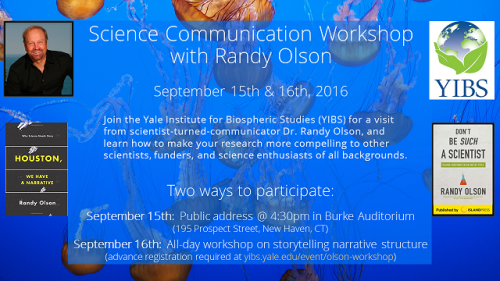
Sign up for YIBS’ science communication workshop with Dr. Randy Olson

August 9, 2016

Registration is now open for our September 16th workshop on science communication with Dr. Randy Olson.

Randy Olson is a scientist-turned-filmmaker and science communicator known for developing the “And, But, Therefore” storytelling narrative style for scientists to tell stories about their research and to make their science more compelling to other scientists, funders, and science enthusiasts of all backgrounds.

Randy is offering two 3-hour workshops on campus on Friday, September 16 to teach Yale students and faculty this storytelling narrative approach. Registration will be capped at the first 50 respondents, but Randy is also offering a public lecture on September 15 for those who cannot join the workshop.


–>Click here for more details and to register for the workshop


News & Updates

An artist’s depiction of Likweli, a new Colobus monkey species that inhabits forest canopies in the Democratic Republic of Congo and is difficult to photograph.  Illustration by Kimio Honda

Meet ‘Likweli’: A new monkey species discovered in the Congo Basin

July 15, 2026
An international team of scientists, including Yale researchers, has described a new Colobus monkey species inhabiting high forest canopies in the Democratic Republic of...
Distinctive spiral striations on the teeth of extant species of Cyclothone — the world’s most numerically abundant fish genus — match striated patterns on fossilized teeth dated to more than 55 million years ago.  Photo by Karinne Tennenbaum

Tiny teeth fossils reveal ancient origins of ocean’s most abundant deep-sea fish

July 2, 2026
The deep sea, which is typically defined as depths of at least 200 feet, is home to 90% of marine fish life, but the fishes that inhabit it are poorly represented in the...
Southern Appalachian salamander at Grandfather Mountain State Park, North Carolina.

The secret lives of salamanders

June 22, 2026
For her doctoral dissertation, Yale’s Nathalie Alomar decided to study a small amphibian that appeared to have eluded the forces of evolution.  She found that there is more...