Yale researchers have discovered two new species of darter — small, colorful freshwater fishes — inhabiting short stretches of creeks and streams in central Alabama.
And they already know that both species are critically imperiled.
In a new study, published April 22 in the journal Biology Letters, the researchers describe the newly discovered species — and argue that the methods used to identify them, which combine genomic sequencing with analyses of physical features, bolster efforts to protect Earth’s biodiversity.
“The delimitation of species forms the foundation of conservation efforts,” said Thomas J. Near, professor of Ecology and Evolutionary Biology in Yale’s Faculty of Arts and Sciences, YIBS faculty affiliate, and senior author of the study. “In other words, we can’t protect threatened species if we haven’t named and described them.
“The description of these endangered species of freshwater fishes highlights the value of deploying genomic resources to discover, delimit, describe, and protect imperiled species,” he said.
Chase D. Brownstein, a graduate student in Ecology and Evolutionary Biology in Yale’s Graduate School of Arts and Sciences is the study’s lead author.
Researchers discovered the two new species in isolated populations in the Mobile River drainage system, which is located within the southeastern North American freshwater biodiversity hotspot — home to the planet’s most species-rich freshwater ecosystems outside of the tropics.
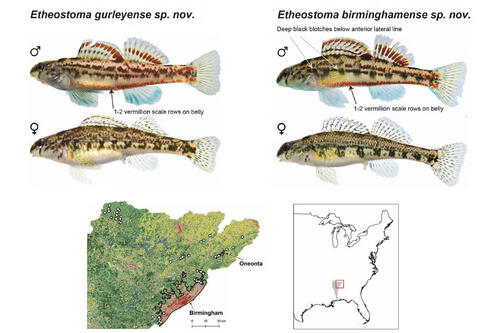
The new species are named the Gurley Darter (Etheostoma gurleyense) and the Birmingham Darter (Etheostoma Birminghamense). Together with the endangered Vermillion Darter and vulnerable Warrior Darter, Locust Fork Darter, and Sipsey Fork Darter the two new species form a group of snubnose darters that share common ancestry from about 5 million years ago, the researchers said.
The researchers distinguished the species from each other based on different physical characteristics, such as coloration and the composition of fins, and their genetic makeup. Populations of the new species inhabit very short reaches of creeks and streams within the drainage system and are geographically and genetically isolated from each other, according to the study.
They say that the Birmingham Darter and Gurley Darter, which inhabit streams surrounding the City of Birmingham, are the most imperiled as their ranges overlap with intensive urban and agricultural development.
The threat is particularly grave for the Birmingham Darter, which only persists in short stretches of two creeks, the researcher said. They found that the species has entirely disappeared from a third creek where it was consistently documented from 1966 through 2006. The species’ restricted range faces severe threats, including water pollution, sedimentation from agricultural runoff and urban development, and habitat destruction from coal strip mining activities in the region.
Of the six species composing the snubnose darter group, only the Vermillion Darter, which was first described in 1992, is currently protected under the federal Endangered Species Act.
For more information, click here for an article published by Yale News or here for the full study in Biology Letters.