
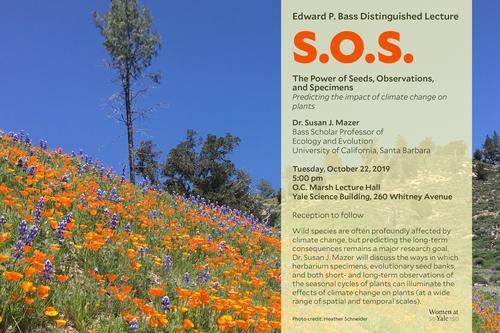
Edward P. Bass Distinguished Lecture: “S.O.S. – The Power of Seeds, Observations, and Specimens: Predicting the impact of climate change on plants”

October 22, 2019
Event Date: 
Tuesday, October 22, 2019 - 5:00 pm
Reception to follow
 
Location: 
O.C. Marsh Lecture Hall, Yale Science Building see map 
260 Whitney Avenue

New Haven, CT 06511


Wild species are often profoundly affected by climate change, but predicting the long-term consequences remains a major research goal. Dr. Susan J. Mazer will discuss the ways in which herbarium specimens, evolutionary seed banks, and both short- and long-term observations of the seasonal cycles of plants can illuminate the effects of climate change on plants at a wide range of spatial and temporal scales.

Dr. Susan J. Mazer, Bass Scholar and Professor of Ecology and Evolution, University of California, Santa Barbara

Photo credit: Heather Schneider

News & Updates

An artist’s depiction of Likweli, a new Colobus monkey species that inhabits forest canopies in the Democratic Republic of Congo and is difficult to photograph.  Illustration by Kimio Honda

Meet ‘Likweli’: A new monkey species discovered in the Congo Basin

July 15, 2026
An international team of scientists, including Yale researchers, has described a new Colobus monkey species inhabiting high forest canopies in the Democratic Republic of...
Distinctive spiral striations on the teeth of extant species of Cyclothone — the world’s most numerically abundant fish genus — match striated patterns on fossilized teeth dated to more than 55 million years ago.  Photo by Karinne Tennenbaum

Tiny teeth fossils reveal ancient origins of ocean’s most abundant deep-sea fish

July 2, 2026
The deep sea, which is typically defined as depths of at least 200 feet, is home to 90% of marine fish life, but the fishes that inhabit it are poorly represented in the...
Southern Appalachian salamander at Grandfather Mountain State Park, North Carolina.

The secret lives of salamanders

June 22, 2026
For her doctoral dissertation, Yale’s Nathalie Alomar decided to study a small amphibian that appeared to have eluded the forces of evolution.  She found that there is more...