
Joint Mobility as a Bridge Between Form and Function

Armita R. Manafzadeh - Fig. 1
January 26, 2023

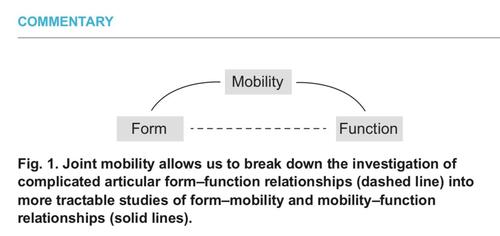
In a recent article published by the Journal of Experimental Biology, Armita Manafzadeh (YIBS Gaylord Donnelley Postdoctoral Associate) examines how joints enable nearly all vertebrate animal motion, from feeding to locomotion. However, despite well over a century of arthrological research, we still understand very little about how the structure of joints relates to the kinematics they exhibit in life. This Commentary discusses the value of joint mobility as a lens through which to study articular form and function. By independently exploring form–mobility and mobility–function relationships and integrating the insights gained, we can develop a deep understanding of the strength and causality of articular form–function relationships. In turn, we will better illuminate the basics of ‘how joints work’ and be well positioned to tackle comparative investigations of the diverse repertoire of vertebrate animal motion. To read the full article, please click here

News & Updates

Corrie Moreau, CALS Senior Associate Dean, Moser Endowed Professor of Arthropod Biosystematics and Biodiversity Director, and Head Curator of the Cornell University Insect Collection

Edward P. Bass Distinguished Lecture: Ants, microbiomes, and how I became a rainforest explorer

April 22, 2026
Professor Corrie Moreau, head curator of the Cornell University Insect Collection, has explored rainforests around the world in search of the most diverse and ecologically...

YIBS Postdoc Armita Manafzadeh wins young investigator award for paleontology research

December 8, 2025
Armita Manafzadeh, a postdoctoral researcher affiliated with the Yale Institute for Biospheric Studies, the Department of Earth & Planetary Science, and the Yale Peabody ...

Back to the beach: Why did evolution return some animals to the water?

November 20, 2025
In most narratives, the story of evolution is the story of organisms emerging from the ocean and eventually populating the land. But for some species that evolution also...