
Study Develops Technique for Creating Strong, ‘Moldable’ Wood Materials

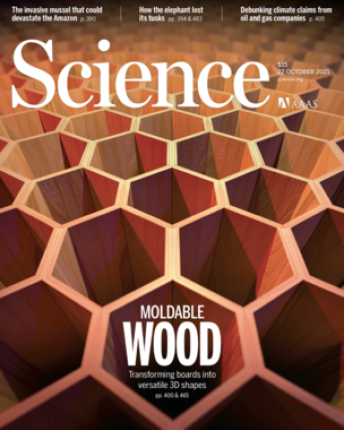
Oct. 22, 2021 Science Cover
November 10, 2021

A new study published in Science details an innovative new process that breaks down the wood’s cell walls and allows the material to be reconstituted via a “water-shock” treatment. The study, led by a research team at the University of Maryland and which included YIBS Affiliated Faculty Member, Yuan Yao (Assistant Professor of Industrial Ecology and Sustainable Systems at YSE), started by breaking down the wood’s lignin component — the wood’s cell walls that give it strength. The broken fibers were then closed by evaporating water, then the wood was “re-swelled” in “a rapid water-shock process that selectively opens the vessels.” The resulting material has a wrinkled cell wall structure that allows the material to be molded into desired shapes as 3D-molded wood — with a constitution six times stronger than the original wood material and comparable to other lightweight materials, like aluminum alloys. The strong mechanical property, the research team says, could “widen wood’s potential as a structural material, with lower environmental impact for buildings and transportation applications.” To learn more, please click here for an article published by the Yale School of the Environment.

News & Updates

An artist’s depiction of Likweli, a new Colobus monkey species that inhabits forest canopies in the Democratic Republic of Congo and is difficult to photograph.  Illustration by Kimio Honda

Meet ‘Likweli’: A new monkey species discovered in the Congo Basin

July 15, 2026
An international team of scientists, including Yale researchers, has described a new Colobus monkey species inhabiting high forest canopies in the Democratic Republic of...
Distinctive spiral striations on the teeth of extant species of Cyclothone — the world’s most numerically abundant fish genus — match striated patterns on fossilized teeth dated to more than 55 million years ago.  Photo by Karinne Tennenbaum

Tiny teeth fossils reveal ancient origins of ocean’s most abundant deep-sea fish

July 2, 2026
The deep sea, which is typically defined as depths of at least 200 feet, is home to 90% of marine fish life, but the fishes that inhabit it are poorly represented in the...
Southern Appalachian salamander at Grandfather Mountain State Park, North Carolina.

The secret lives of salamanders

June 22, 2026
For her doctoral dissertation, Yale’s Nathalie Alomar decided to study a small amphibian that appeared to have eluded the forces of evolution.  She found that there is more...